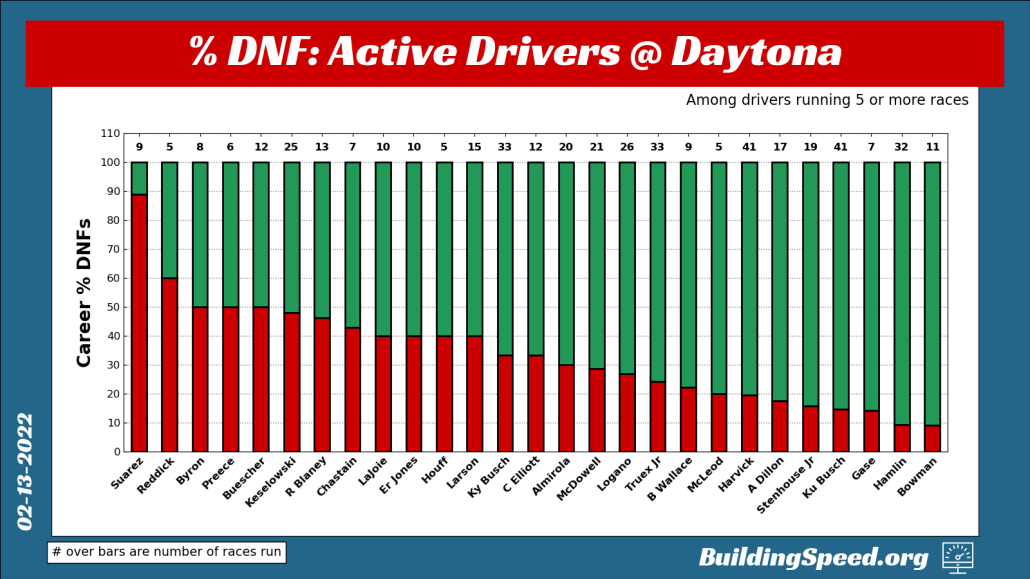
There is absolutely nothing magic about the 200-mph mark.

People have been treating the 200-mph number like it was handed down by a sacred oracle.

First off, a series of factors are required to make a car go airborne.  ONE of them is high speed.  Another is the car getting turned around at just the right angle.  It’s not like the minute a car goes faster than 200 mph, it is in imminent danger of becoming airborne.  The higher the speed, the higher the probability the car can leave the ground — IF other factors are also present.

Secondly, today’s car has very different aerodynamics than previous versions of the car.  NASCAR apparently feels confident that the 202-205 mph range does not raise the probability of a car becoming airborne significantly.  John Darby specifically said that NASCAR had wind tunnel testing data that led them to this conclusion.  NASCAR believes that the slight increased risk is small relative to other benefits (the most significant of which appear to be saving engine builders/tuners from having heart palpitations due to the engines turning very high sustained rpms).

If you can’t let go of thinking about 200 mph holding some mystical power, remember that 200 mph is really just 321.9 kilometers per hour.

Doesn’t sound so magical that way, does it?


Thursday marks the first time we’ve had an open test at Daytona in a couple of years.  With the myriad rules changes aimed at getting away from two-car drafting, the teams are going to need to make the most of these sessions — especially if NASCAR opts to make more changes before Daytona
 

Below, a short video explaining why radiators are such a big deal at Daytona this year.  As always, happy to answer questions you might have! Drop them in the comments and I’ll reply. Or send them to me @drdiandra on twitter.


Ray Evernham was one of the first people who realized the carbon monoxide (CO) has an effect on driver that could be affecting his performance.

“(I could tell immediately) …by the way Jeff answers me on the radio, whether the carbon monoxide is getting to him.  He becomes a smartass. But the more I got to know him and the more I learned about carbon monoxide, the more I realized what was happening.”

I usually talk about the development of the catalyst in talks I give. I was very embarrassed to have put this PPT slide up at Notre Dame with priests in the audience.


TNT is offering a million dollars to anyone who picks the top ten drivers – in order – at any of the six races they broadcast.  You have up until 25% of the race has been run to lock in your selections, which means up to mile 100 at Daytona this weekend.   How likely are you to win?

You have a 1 in 43 chance of picking the first driver correctly.  There are now 42 drivers left and you have a 1 in 42 chance of picking the second driver correctly.  When you calculate the probability of doing two things, you multiply the probabilities.  It makes sense that there ought to be less probability of picking two numbers in a row than of picking one, right?  So the odds of picking two drivers in the right order is 1 in (43 x 42) or 1 in 1,806.

Continuing this pattern…

# picked in right order

Calculation Chances are …
1 1 in 43 1 in 43
2 1 in (43 x 42) 1 in 1806
3 1 in (43 x 42 x 41) 1 in 74,046
4 1 in (43 x 42 x 41 x 40) 1 in 2,961,840
5 1 in (43 x 42 x 41 x 40 x 39) 1 in 115,511,760
6 1 in (43 x 42 x 41 x 40 x 39 x 38) 1 in 4,389,446,880
7 1 in (43 x 42 x 41 x 40 x 39 x 38 x 37) 1 in 162,409,534,560
8 1 in (43 x 42 x 41 x 40 x 39 x 38 x 37 x 36) 1 in 5,846,743,244,160
9 1 in (43 x 42 x 41 x 40 x 39 x 38 x 37 x 36 x 35) 1 in 204,636,013,545,600
10 1 in (43 x 42 x 41 x 40 x 39 x 38 x 37 x 36 x 35 x 34) 1 in 6,957,624,460,550,400

That’s one in 6.9 quadrillion to get all ten in the right order.

Is Picking Them in Order Harder?

What if TNT had just said you had to get all ten, in no particular order?

If you look at ten numbers, there are ten ways of picking the first number, nine of picking the second, etc. That multiplies out to there being (10 x 9 x 8 x 7 x 6 x 5 x 4 x 3 x 2 x 1=) 3,628,000 different ways of organizing ten numbers in every which way possible.

If TNT had decided that you only needed to get the drivers right, but not the order, your chances would increase to a whopping 1 in 1,917,334,783.

But there aren’t Really 43 Drivers Capable of Placing in the Top Ten…

OK, in reality, the odds are a little better.  The calculation above assumes that the finish is a totally random event and we know that it’s not because there are 7-9 start and parkers.  Realistically, you’re picking from maybe 35 cars (8 S&Ps), so the odds for getting all ten in the right order if you’re only picking from 35 drivers are 1 in 818,441,006,423,040. or 1 in about 818 trillion.

But there aren’t Even Really 35 Drivers Capable of Placing in the Top Ten…

Yeah, the husband tried to make the argument that you’re really only choosing from about 17 or maybe 20 drivers.  Five words:  Regan Smith and Trevor Bayne.

Just for comparison…

Odds of being struck by lightning are 1 in 576,000.
Odds of being killed by lightning are about 1 in 2,320,000
Odds of a meteor landing on your house: 1 in 182,138,880,000,000

So you’ve got a better chance of a meteor landing on your house than winning that million dollars.

Often for promotions like this (free televisions if it snows 10 inches on New Year’s Day!!), a company will take out an insurance policy.  They’ll pay some amount of money to hedge against paying more.  The people at the insurance company who figure out how much to charge them use these types of calculations to figure out the risk.  I’m guessing TNT wouldn’t want to pay much of a premium because the odds are clearly in their favor.  But it’s a great promotion.

Does this mean you shouldn’t play?  Heck no – TNT isn’t charging you to enter, so get your best guess together and see if you can beat the odds.

RANDOM NOTES

Look at this cool project from Clemson and DuPont to take middle and high school teachers to the racetrack and teach them about science!  Way to go, Tigers.

The probability of becoming a saint is estimated at about one in 20 million, but if you’re Jacques Villeneuve, the odds rise to one in a flying pig.

Gratuitous link to The NASCAR Insiders just because their Wednesday Q&A is always worth checking out – it is a blog I always learn something from!

Daytona this weekend – read all about drafting vs. bump drafting, why you’re likely to see two but not three cars drafting together, why NASCAR limits radiator pressure to try to keep the two-car draft to a minimum, and why drivers shift to the right to get air to the engine if they’re turning left.  Or take a look at the Science of Speed video on drag and drafting.


Jack asks:

I’m curious as to why the rear cars are offsetting to the right, when offsetting to the left would let the rear driver see what is happening ahead of them and keep the radiator in cooler air, since the exhaust on these cars is on the right. I know that all those drivers and crew chiefs are smarter than I am, so I must be missing something.

Thanks for the question, Jack. Give yourself a little more credit: you bring up some really good points that I bet a lot of people didn’t see.

Drafting at Daytona has become more important than ever, with the two-car draft being the most effective means of getting speed. The problem is that this mode of drafting completely blocks the front grille, and that limits how much air gets in to cool the engine.  The trailing car has to back off to let air into the grill when the engine gets warm.

Jack noticed that everyone was shifting to the right.  I think it’s a matter of simple geometry and the fact that NASCAR is chiral.  Chiral means simply that something twists one way.  All of your DNA twists in one direction.  NASCAR drivers turn (with two exceptions a year) right left.  (Note:  Thanks to the commenter.  What WAS I thinking there?)

Below, I’ve drawn two cars trailing each other in line on the left, the trailing car shifted to the right (middle) and the trailing car shifted to the left (right).

When cars turn left, a natural gap opens up on the right-hand side between the cars.  Moving to the right takes advantage of the gap and makes it slightly larger.  If the trailing car moves to the left, I don’t think it’s going to get as much air.  So despite the possibility of being able to see better, going to the left doesn’t look as effective to me as shifting to the right is if the goal is to get the most air into the engine.

Thanks for asking the question, Jack!  I always read the comments, so if you have a question you’d like answered, please leave it in the comments for me.


Any closed vessel that is subjected to high temperature will experience increasing pressure.  When that pressure gets high enough, we change from calling it a pressure vessel to a bomb because if(when) it explodes, the vessel itself becomes a collection of high-speed projectiles.  For safety, we don’t heat closed containers if there’s a chance they will reach high enough pressure for them to explode.  A pressure cooker, for example, has a relief valve that at one time was as simple as a rubber stopper tightly fitted into the lid.  The rubber stopper fit in the hole securely enough to handle up to some cutoff pressure, then popped out when that pressure was exceeded.  (This is not an ideal safety mechanism because the flying stopper can injure someone, as can the blast of steam that dislodged the stopper.)

A more practical version is a valve that automatically opens when the pressure exceeds some cut-off value.  The open valve allows excess steam (and sometimes water) to escape.  As soon as the pressure is below the cut off, the valve closes again.  In addition to being safer, it eliminate the time-wasting step of looking for the stopper.

The cooling system on a car is a prime example of a closed system that is heated to high temperature.  Water is pumped through holes in the engine block, where it collects heat.  The now-hot water moves out of the engine and into the radiator, where the heat is transferred from the water to air surrounding the radiator.  The cooled water returns to the engine to pick up more heat.  A Sisyphusian task, indeed.

A radiator is a twist of metal tubing onto which is fastened thousands and thousands of fins that help cool the water that circulates through it.   A typical stock car radiator (like the one at left) might have 20 fins per inch (compared to 10 fins per inch on a typical car radiator).  The more fins per inch, the more surface area available for exchanging heat between the radiator water and the outside air; however, air has to pass through the radiator, so if there are too many fpi, the air flow is decreased and that lessens the cooling.

The water can only carry away so much heat on each trip, so the water temperature gets hotter and hotter as long as the engine keeps producing heat.  The water increases in pressure as the temperature increases.  (See Equation, Clapyron for more on that.)   Water, of course, boils at 212 degrees Fahrenheit, and that would seem to set a limit on how hot you can run an engine; however, there’s a caveat.  Water boils at 212 F only at atmospheric pressure.  As the graph below shows, the higher the pressure, the hotter the water can get before it boils.  Atmospheric pressure is right about 14.7 psi, and that’s where the 212 degree Fahrenheit number applies.  But if you can get the pressure of the system up to about 45-48 psi, the water won’t boil until 275-280 F.  If you can maintain a high pressure in your radiator, you can prevent the water from turning into steam.  Water is much better at carrying away heat than steam is.  Water also flows much better.  Most radiators have a pop-off valve that blows when the pressure gets too high.  A typical radiator cap on a car would be about 15 psi, which actually means 15 psi above atmosphere.  Atmosphere is 14.7 psi, so you’re looking at about 29.7 psi in absolute terms.  This is why your radiator cap has all of those warnings about not removing it while the car is hot:  when the system is vented (opened to atmosphere), the super-hot water will turn into super-hot steam and gush from the opening.

A pop-off valve serves as a ‘weak link’: it has to blow before anything else in the system blows.  Most radiator caps on passenger cars are spring loaded:  When the pressure gets too high, the cap lifts off its seat, opening the system and allowing the hot water to escape into a reservoir.  As soon as the pressure is back down, the radiator cap goes back to being closed.

In a NASCAR car, the pop-off valves open and route the escaping steam and/or water through a tube that passes up near the right-hand side of the car’s windshield.  When you see a car “pushing water”, the maximum pressure has been exceeded and the pop-off valve opened.

For the last couple of years, most of the top NASCAR engine shops have focused on strengthening radiators.  It’s not difficult to get a pop-off valve set to 100 psi.  The problem is that if the pop-off valve isn’t the weak leak in the system, something else breaks.  It’s much more expensive to replace a radiator than a valve – so the size of the pop-off valve is really limited by the strength of the radiator.   A stronger radiator allows a higher pressure to be maintained.  Tim Brewer said that teams were pressurizing their systems to 80 psi (which would be 94.7 psi on my graph were it to extend to the right.)

Two-car drafting produces very high speeds, and that makes NASCAR nervous.  Cutting down the restrictor plate (which they did today) slows down the cars, but NASCAR doesn’t want to change the plate more that 1/64th of an inch or two because the change in plate size significantly affects how air enters the engine.  Teams have been designing engines around a particular plate size, although you would think that by now, they’d know to test not only the announced size, but plates one or two sizes up and down.

The limiting factor on how long two cars can stay in a draft is temperature.  The air intake of the trailing car is blocked when it is drafting, and the water temperature increases.  Two cars could go twenty laps or more before they had to separate.  NASCAR’s plan to limit the two-car draft started with a mandated pop-off valve.  NASCAR requires all teams to use a 33-psi pop-off valve, which corresponds to (33+14.7=47.7 psi) in my graph above.  All the work teams did to manage an 80 psi pressurized system is now out the window.  They also decreased the size of the opening through which air enters the car to cool the engine.  Less air reaching the radiator means less heat transferred from the water and a warmer engine.

Now if someone only could come up with a pop-off valve for drivers…

*****

EXTRA:  Wondering about the different between a tapered spacer and a restrictor plate?  Check out this video, which illustrates very visually how a fluid flows differently through an orifice (the plate) and a nozzle (the spacer).  They’re using both on the Nationwide cars now.  The way the air enters the engine really makes a difference in the combustion dynamics.  Making a smaller spacer would have created too big a perturbation.  The holes in the new space are actually larger, but the plate will help decrease the overall flow.


The most talked-about feature of the racing at the ‘new’ Daytona is the two-car hookup.  Just in time for Valentine’s Day, drivers are finding that the term ‘drafting partner’ is more accurate than ever before.  Why two and not three-, four- and larger packs that used to be characteristic of Daytona?

Drafting 101

Anytime you move forward, you are working against something.  To walk through a swimming pool, you have to push  water molecules out of your way.  To drive through air, you have to push the air molecules out of the way.  The faster you go, the more air molecules you have to push out of the way in a given time.

Aerodynamic Forces on Cars

I’m going to focus on just the forces acting along the length of the car, ignoring sideforces.  The key to my drawings is that the length of the arrows and their color indicates speed.  Long green arrows indicate fast moving air, while red short arrows indicate slow moving, denser air.   Some air gets under the car, while most of it goes up and around.

We are interested in two primary features:  The front of the car acts like a wedge, pushing air out of the car’s way.  The air molecules resist this motion, creating a force that pushes in the direction opposite the car’s motion.  As the air passes over the car, it becomes turbulent at the back end, creating a partial vacuum at the rear of the car.  The physical phenomena at the front and the rear of the car are different, but they have the same effect:  they slow the car down.  We can get rid of the little arrows and just represent the force of the air as arrows pushing against the front of the car and pulling backward on the rear of the car.

If the two cars are far apart, each car experiences forces on the front and the rear of the car.  When they get close enough to each other, they appear as essentially a single object.  The trailing car is traveling in the aerodynamic shadow of the first car, so it doesn’t get the huge blast of air on its hood.  The trailing car prevents the air from getting as turbulent at the rear of the first car, so the force sucking back the first car is reduced.  (To learn more, or at least see much better drawings than mine, see the Science of SPEED video.)

Drafting 102

Every television program explains the very basic aspects of drafting, but we need to go a little deeper to understand what’s different now.

The most important change in the car has been the improved match up between the rear and front bumpers with the new car.  To get the maximum benefit from drafting, you really want the two objects to look like one, which means that they need to be as closely matched as possible.   Compare the  diagrams to the right.  In the top diagram, two different shaped objects will have turbulence between them because of the height difference.  (If the heights were reversed, there would be extra front drag.)

The second diagram shows two shapes that are the same size, but not very close to each other.  They are so far apart that both experience the front drag and the rear turbulence.

The lowest diagram shows two objects of the same size fit right up against each other.  The air travels over the two objects as if they were one.  The better the back end of the first car and the front end of the rear car fit, the more of an advantage you will get from drafting.  I apologize for my terribly drawing.  Graphics has never been one of my strong points.

With the old car, cars could usually add 5-10 mph by drafting.  We’re seeing much larger increases now – qualifying speeds are running 185 mph, while we’re seeing 205+ mph in the draft.  This tells me that the cars fit together aerodynamically significantly better than the old cars did.

Why the Two-Car Draft Works Better than Before

The new car was introduced in 2007 and although the splitter has changed, that’s likely not the big effect.  Drivers report that the repaving has really changed the character of the track.  It’s got more grip, but the biggest effect is probably the smoothness.  The key to good drafting is maintaining the relative positions of the two cars:  they have to be close.   Now the third dimension becomes important.  The figure at left is meant to be a top view of two cars driving to the right, so we’re looking at the path of air around the sides of the cars.

On the top figure, the two cars are in perfect alignment, so the air can flow past them smoothly.  If the trailing car stays the same distance behind the leading car, but slips slightly to the right, you’ve introduced edges.  The top part of the trailing car (in red) now is having to push air aside.  On the right sides of the cars, the misalignment of the trailing car means that there is a rear edge, and that means turbulence.

The old Daytona was bumpy.  Those bumps made the cars move up and down relative to each other (which would decrease drafting effects).  The bumpiness also made it harder for the drivers to control the cars, which made it more difficult to keep the cars aligned and close to each other.  The new, smoother track seems to allow the drivers to keep the cars tucked up.  The pull of the draft is so significant that we’re hearing drivers say that they have to ride the brakes.  This is mostly unheard of -usually, crew chiefs have to remind the drivers to pump the brakes before hitting pit road because the brakes get very cold since the only place they were used was on pit road.  Jaime McMurray had a brake rotor fail during practice and trashed his primary car when he blew a tire running over a piece of the broken rotor.  That’s a surprising thing to happen at Daytona.

Hot Engines

One piece of evidence supporting the hypothesis that the cars are staying together better is rising engine temperatures.  Air hitting the front of the car does produce drag; however, it also provides the air that goes into the car and cools the water in the radiator.  If you draft too long, the trailing car’s engine starts to overheat.  If you move to the side to try to expose the intake vents, you increase the drag and decrease the effectiveness of drafting.

One rumor is that NASCAR is going to require pop-off valves that would decrease the maximum temperatures the engines could reach.  (How that works is a separate article.)  This would decrease how long two cars could draft before they would have to separate or switch positions so that their engines didn’t overheat.

Why Two and Not Three

Go get three oranges from the kitchen.  Try to juggle two of them.  Not super easy, but not impossible.  Now juggle three.

The reason we’re seeing two-car drafts and not three is that it is very hard just to keep two cars in position with each other without hitting each other or overheating.  You’re asking the drivers to keep their minds focused on a lot of things, all while driving 200+ mph.

When two cars hook up, they take off.  A third car would have to be right there in position, ready to latch on. All three drivers would have to focus on keeping the pack together.  That’s far different than the old version of drafting, where becoming and staying part of the pack was easy… and fast.  It’s additionally complicated because the old version drafting didn’t require the trailing driver to use his brakes.  We’re seeing a lot more sudden drafting breakups as drivers realize they are overheating.  Do you want to try to get precisely positioned behind someone at 200 mph who is dragging his brakes?  The probability of getting two things to function together precisely is low.  Add a third and it becomes very, very difficult to do.

The Fix?

Speeds reached 206 mph during the Shootout, which makes aerodynamicists nervous because a sideways racecar going 200+ mph has a strong proclivity to unexpectedly start doing an airplane impersonation.  The usual head-first, tail-last position is just fine at high speeds – there is no reason that a stockcar can’t race at 230 mph or more; however, if the car gets turned sideways at that speed, it can become airborne, even when its roof flaps deploy.  There’s not a magic “take-off” speed below which it is safe because it’s a combination of the speed and the angle the car makes with the direction it is traveling.  We would be fine racing at 210 mph, provided that no one gets turned sideways.  The consequences are uncomfortably large if a car does get airborne. Everyone remembers what happened when Carl Edwards got airborne at Talladega and no one wants to take a chance on that happening next Sunday.  Most prognosticators are predicting that NASCAR will make a change after qualifying.

One quick fix (which has been used before) is to decrease the restrictor-plate size.  This probably isn’t practical because the change in size to compensate for the higher speeds would have to be larger than NASCAR would prefer to make.  The engines are tuned to work with a specific plate size, and changing the plate significantly could disproportionately affect one engine shop relative to others.  This change would address the speeds, but it wouldn’t do anything about having only two-car drafts, which seems to be a problem if you believe twitter to be a representative sample.

The fairly simple fix is to limit the time two cars can be hooked up by making it easier for the radiator to overheat.  If you force the radiator to start leaking steam at a lower temperature, the drivers can’t draft in pairs for as long as they can now.  This is pretty simple to implement and the primary consequence will be sleepless nights for the engine tuners.

Mother Nature will help as well:  the race will be during the day and temperatures will be higher, so there won’t be as much grip on the track.  That should slow down the speeds as well, but it won’t change the preference for two-car drafting.

Etc.

Did you catch what Craig Ferguson said about NASCAR drivers and their understanding of science on the Late, Late Show?  It’s in the first third of this clip.


I have a post over on Cocktail Party Physics explaining why planting trees to offset carbon emissions requires many, many more trees than are currently being planted.  Didn’t want to double post it here, so please head over and check it out.


DLP


Rain has more consequences than just delaying the race.  Track drying is really hard on the surface.  Most materials expand when they heat. (Water is a notable exception).  Asphalt is a mix of different types of rocks held together by an asphalt binder.  When you heat the asphalt with a track dryer, you are putting a lot of heat into the track.  Different materials expand at different rates, and the amount of heat that reaches the inner layers of track is different than the amount on the surface.  The rapid change in temperature creates a lot of stress in the asphalt.  Track surfaces, like people, tend to crack when under stress.

There are already a lot of cracks in the Daytona surface that are covered by sealer and other fixes (like epoxy).  Sealers also expand and contract at different rates, so thoses are high priority places to watch for new problems.  Given the age of the track, it is entirely possible that there are areas that are weak or cracked just under the surface that might be pushed to the brink with a little thermal cycling.  (Thermal cycling being repeated heating and warming.)  The Daytona track folks will walk the track, but all they can see is the surface.  Keep your fingers crossed not only that we don’t have rain delaying or canceling the race, but that we don’t have rain period!  I don’t envy the track personnel today – they are going to be really happy when the track reconstruction starts.

Take a look at my earlier post on the Daytona issue.

Questions:  email diandra(at)buildingspeed.org.  Will try to answer during the race, but there’s a possibility that I’m going to be at Best Buy asking them to “demonstrate” their 3D TV’s!


I wake up in the morning listening to our local NPR station. A couple weeks ago, they said that the George Bush Turnpike was closed due to “a buckle in the road”. My husband commented that he knew Texans had big belt buckles, but he didn’t think they were big enough to shut a whole side of the tollway.

Well, the buckle they were talking about was actually three feet high and spanned two lanes. Apparently, the heavy rains we had received created a lot of pressure in the adjoining retaining wall and that pressure pushed the pavement until it buckled and formed our own little miniature mountain range right there in Carrollton.

The problems at Daytona last Sunday weren’t quite of that magnitude (the pothole was about 9″ x 15″ and only 2″ high, but that tiny pothole impacted a lot more people. Including me, who had assured my husband that the race certainly would be over by five as he planned Valentine’s dinner. What happened and how could it have been prevented?

(photo Bill Friel)

Let’s start with thermal expansion. If you’ve ever had a lid stuck on a jar, or a ring stuck on your finger, you may have tried running the jar or the ring under hot water. The metal jar lid would expand faster than the glass jar, thus loosening the seal and allowing you to remove the stubborn lid. That’s because different materials expand at different rates. Metals expand faster than glass and fingers. (The water also provides some lubrication and in the case of jars, may dissolve anything sticky that might be inbetween the threads.)

Most things expand when heated and contract when cooled. Not water. This is good and bad. On the good side, ice is less dense than water, which means that ice can float on top of a pond while warmer, denser water goes to the bottom. The fish and anything else that wants to survive also goes to the bottom. On the bad side — as you know if you’ve ever left a bottle of soda or juice in your car overnight when it got really cold — water expanding at the wrong time can be a mess.

Water freezing and thawing can wreak havoc in other places. Putting in lawn edging in the North is an exercise in futility because the freeze/thaw cycles push the edging up so that, by April, it’s lying on the ground.

The word ‘cycles’ here is important. Most materials are designed to handle constant loads. A car rolling along a flat surface exerts about the same force everywhere along the surface. When you subject a material to repeated cycles of pulling and pushing on it, eventually, it breaks. You can bend a paper clip back and forth a couple of times, but it gets harder and harder to do, and then finally breaks. Each time you bend the paper clip, you make a little change in its microstructure. It’s like a game of pick-up sticks (or Kerplunk). Everything is fine up to a point, but when you push just a little too far, the whole thing comes down.

Normal temperature changes outside make most things expand and contact. There are joints in concrete sidewalks, for example, to allow for this expansion. Otherwise, two slabs of concrete would start pushing against each other and you’d have your own miniature version of plate tectonics.

Asphalt is made up of two components: aggregate (small pieces of rocks) and binder. Go get a bunch of rocks roughly 1/2 inch in diameter and put them in a jar. Try to pack them as closely as possible. It’s not easy to do, and if you don’t believe me, fill the jar up with water, then measure how much water you got in there.

The rocks are mixed with a liquid binder to hold it together, but in the end, asphalt looks like a sponge: rocks held together by binder, with a little bit of air space inbetween. A typical composition for asphalt might be 80% rock, 15% binder and 5% air voids. Here’s a picture from “The Idiot’s Guide to Highway Paving” showing some asphalt close up.

porous asphalt

You want some porosity in the asphalt. Porosity helps asphalt absorb water. A completely smooth, impervious surface would take a very long time to dry and would be more prone to hydroplaning than a rough surface.

The pores, however, cause problems, too. When water gets between stones and freezes, it exerts stress on the asphalt. Not a lot of stress, but enough cycles of stress will eventually produce weak spots and finally cracks. Once a crack is started, it’s very hard to stop (just like runs in nylons) and everytime a car goes over it, the crack gets wet. The weather in Florida was abnormally wet and cold the last few months. Don’t forget that Daytona was literally underwater last summer.

“Well, why didn’t they take that possibility into account?”, some of you are asking. If there is one thing we ought to be teaching in school science, it is that science never has absolute solutions. You can only increase downforce if you’re willing to pay a price in terms of drag or engine heating.

Likewise, if you engineered a track that was totally impervious to freezing and thawing, it wouldn’t drain well and would take a long time to dry when wet. Florida is much more likely to have rain and a need for lots of track drying than it is to have freezing. No track design is perfect. Although asphalt has been in use for many years (the Sumerians used it way back in 3000 B.C. as an adhesive on statues), we don’t have a lot of data on how highly banked asphalt racetracks that see speeds of 200 mph behave. There are really only two superspeedways, both constructed 1959-1960 and you can tell from the racing that they have very different characteristics, despite their apparent similarities.

Asphalt is not an easy material to work with, either. You start with crude oil, remove everything that seems useful (gasoline, diesel, oil, paraffin, etc.) and the sticky, goopy mess left over is used to make binder. You’ve probably seen (and/or smelled) asphalt machines puffing smoke near highway construction sites. The binder softens when it is warm and hardens when cool. Asphalt is usually laid down around 275-300 degrees Fahrenheit and gradually cools to a solid.

Liquid asphalt patches often consists of asphalt binder in a solvent — the same way pigment molecules are suspended in a solvent to make paint. You apply the liquid and wait for the solvent to evaporate, leaving behind a solid. The problem is that evaporation usually takes a long time. A re-surfaced asphalt driveway usually needs a day or two before it’s ready to be used. Heating will quicken the process, which is why the track workers were using a blowtorch on the patched area. Of course, the area that had the problem was the one part of the track that wasn’t in the Sun and thus was colder than everywhere else!

Eventually, they literally turned to Bondo. (My first car was a ’69 Buick LeSabre, so I know all about Bondo!) Bondo is a two-part putty that cures via a chemical reaction that is significantly less sensitive to temperature than asphalt patches. Of course, Bondo won’t stick as well to asphalt as asphalt sticks to asphalt, so Bondo is not the ideal solution. There’s that tradeoff again: you can make a fast repair that doesn’t last very long, or a slow repair that lasts longer. With a race in progress and FOX rapidly reaching the point where they were ready to interview drivers’ dogs because everyone else had already been interviewed, any repair that would get us to the end of the race was the right one.

Repaving is estimated at about $20 million dollars, and there’s no guarantee that (if it had been done between February and July ’09), the torrential rains of summer ’09 and the cool weather wouldn’t have caused problems. The next repave is tentatively scheduled for February 2012. Repaving can totally change the character of a track and not always for the better. They have plenty of time to patch the track between now and July (although there are other events scheduled for the track). An in-depth evaluation by an engineering company is in process. Whether patching will be sufficient or a total re-paving is necessary will be determined by the results of that evaluation. And while the folks doing the evaluation are some of the best in the business, the nature of the world is that there are no guarantees. The only Law of Nature that is certain is Murphy’s Law.

© 2012 Suffusion theme by Sayontan Sinha